
Difference Between Freehold and Leasehold Property (Complete Guide for Buyers)
When buying property in India, one of the most common and confusing questions buyers ask is:
“What is the difference between freehold and leasehold property?”
Understanding this difference is extremely important because it directly affects ownership rights, resale value, bank loans, legal safety, and long-term returns. Many buyers unknowingly purchase leasehold properties thinking they are full owners, which later creates problems during resale or transfer.
In this detailed guide, we explain freehold vs leasehold property, their advantages, disadvantages, legal meaning, and which option is better for investment or living.
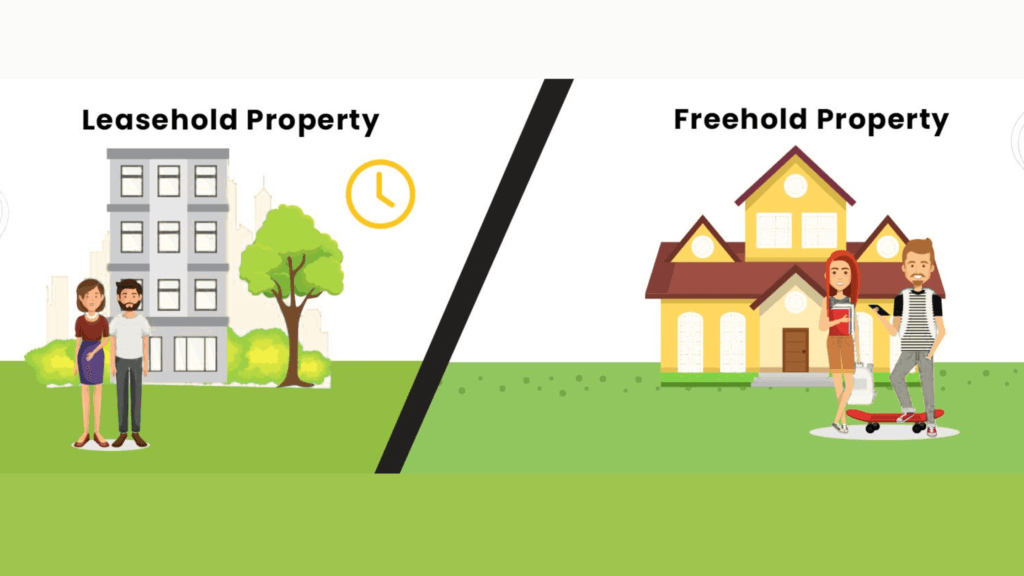
What Is Freehold Property?
A freehold property means you have complete ownership of both:
The land
The building constructed on it
As a freehold owner, your name is registered permanently in government records, and you have full legal rights over the property.
Key Features of Freehold Property
Absolute ownership with no time limit
Can be sold, transferred, gifted, or inherited freely
No permission required from any authority for transfer
High resale value
Easily approved by banks for home loans
In simple words, freehold property = full control + lifetime ownership.
What Is Leasehold Property?
A leasehold property means the land is owned by a government authority or development body (such as DDA, Noida Authority, GNIDA), and it is leased to the buyer for a fixed period, usually 30, 60, or 99 years.
You can use the property during the lease period, but you do not own the land permanently.
Key Features of Leasehold Property!
Ownership is valid only for the lease duration
Land remains with the original authority
Transfer requires permission and charges
Lower initial cost compared to freehold
Loan approval may be limited
Once the lease period expires, the property must be renewed or returned as per the authority’s rules.
Major Difference Between Freehold and Leasehold Property!
| Feature | Freehold Property | Leasehold Property |
|---|---|---|
| Ownership | Permanent | Temporary |
| Land Ownership | Yes | No |
| Time Limit | Lifetime | Fixed period |
| Transfer Rights | Easy | Permission required |
| Bank Loan | Easily available | Limited or strict |
| Resale Value | High | Comparatively lower |
| Legal Control | Full | Partial |
| Renewal | Not required | Required after expiry |
Advantages of Freehold Property
1. Complete Ownership
Freehold owners enjoy absolute rights over their property. There is no dependency on any authority.
2. Better Resale Value
Freehold properties are always in higher demand, making them easier to sell at better prices.
3. Easy Home Loan Approval
Banks and financial institutions prefer freehold properties due to lower legal risk.
4. No Renewal Worries
Unlike leasehold, there is no lease renewal cost or risk.
5. Ideal for Long-Term Investment
Freehold plots and houses offer better appreciation over time.
Disadvantages of Freehold Property
Higher purchase cost
Stamp duty and registration charges may be higher
Full responsibility for maintenance and compliance
However, these drawbacks are minor compared to the long-term benefits.
Advantages of Leasehold Property
1. Lower Initial Cost
Leasehold properties are generally cheaper than freehold, making them attractive for budget buyers.
2. Located in Prime Areas
Many leasehold properties are situated in well-developed government zones.
3. Suitable for Short-Term Use
Good option if the property is required for temporary or commercial use.
Disadvantages of Leasehold Property
1. Limited Ownership Rights
You do not fully own the land, which restricts your legal authority.
2. Renewal Uncertainty
Lease renewal depends on government policies and charges.
3. Complicated Transfer Process
Selling or transferring leasehold property requires permission and fees.
4. Lower Loan Eligibility
Banks may refuse or limit loan amounts on leasehold properties.
5. Lower Long-Term Appreciation
As the lease period reduces, resale value decreases.
Which Is Better: Freehold or Leasehold Property?
Choose Freehold Property If:
You want long-term ownership
You are buying for investment
You plan to sell in the future
You want hassle-free legal ownership
Choose Leasehold Property If:
Your budget is limited
You need property for short-term usage
The location is prime and well-developed
Lease duration is long (90–99 years)
Freehold vs Leasehold Property in India (Real Estate Perspective)
In cities like Noida, Greater Noida, Delhi, and NCR, many properties are originally leasehold but can be converted into freehold by paying conversion charges.
Most real estate experts strongly recommend freehold property for investment and residential purposes, especially plotted developments.
Can Leasehold Property Be Converted to Freehold?
Yes, in many cases. Authorities allow conversion by:
Paying conversion charges
Clearing dues
Submitting required documents
Once converted, the property becomes freehold, increasing its market value.
Legal Tips Before Buying Property
Always check title deed and ownership type
Verify RERA registration
Confirm lease duration (if leasehold)
Ask about conversion possibilities
Consult a real estate legal expert
Final Verdict
Understanding the difference between freehold and leasehold property is crucial before making any real estate decision.
– Freehold property offers security, freedom, and better returns.
– Leasehold property may be cheaper but comes with limitations and risks.
For safe investment, long-term growth, and peace of mind, freehold property is generally the better choice.
